Showing posts with label vietnam. Show all posts

Wednesday, November 21, 2012

Quy Nhơn

September 2 National Day rolled around once again to bring a few days off for Bảo, so we decided on a trip to Quy Nhơn city in the central province of Bình Định. It is a long trip from Vũng Tàu, about 14 hours by coach but because there are so many fisherman from the province living in Vũng Tàu there is a daily service of two coaches. One of them is a standard reclining seat coach, but the other is a sleeper. Bad luck, though, that it was already booked out for the trip north, although the standard coach was fairly comfortable for the overnight trip which got us to Quy Nhơn at about 530 in the morning.

Why go to Quy Nhơn? This was the question that all my students kept asking me. The short answers are: because we have a friend there (Dũng, a talented singer); because I want to go. Truth be told, there is not a lot to do there but the scenery is very interesting. There are also a few important cultural sites.

The landscape of Quy Nhơn is very different to Vũng Tàu because the mountains, which are part of the Trường Sơn range come all the way to the sea. Rather surprisingly many of them are covered by either conifers or eucalyptus trees, which makes me think that the area around the city may have come under heavy or repeated attack during the war.
Because of the mountains, the coast has many small sandy or rocky coves, and most of these have been developed into day resorts. We spent half a day + lunch at one of these where the water was the clearest and cleanest I have ever seen in Vietnam or in many other places! Such a difference to swim in compared to beaches at Vũng Tàu. During the visit it poured rain but most people just kept on swimming and playing :).

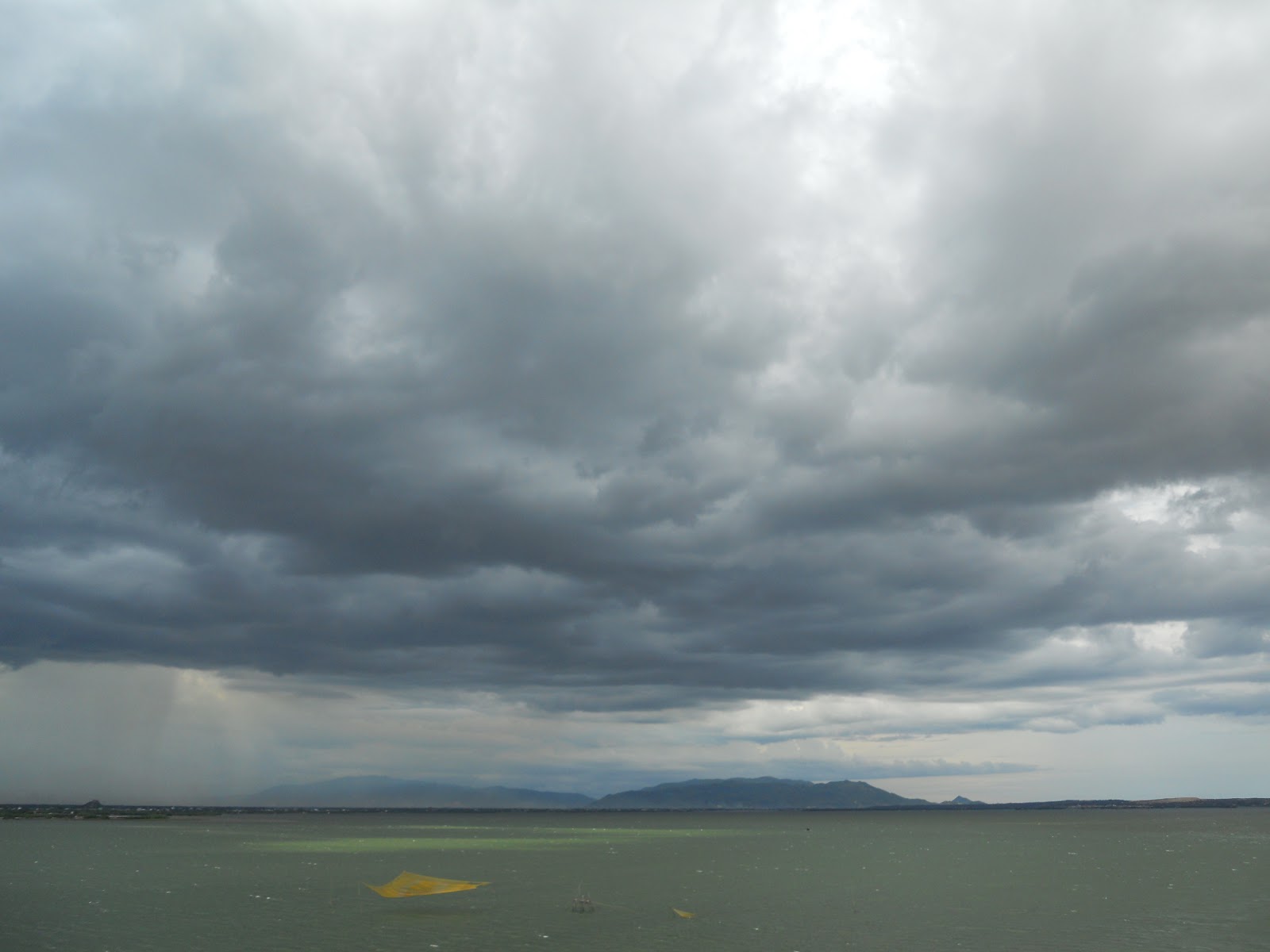
Another geographical feature is the Thị Nại lagoon which separates Quy Nhơn city from the Phương Mai peninsula, and is fed by the Tây Sơn river. The peninsula can now be reached by a newly constructed 2.5 km sea-bridge.
Another famous resort lies much closer to Quy Nhơn city. Ghênh Rang resort started life as a royal holiday spot and is best known for Bãi Dá Trứng - stone egg beach - and the second grave of a famous Vietnamese poet known as Han Mac Tu. He lived at the beginning of the 20th century, suffered from leprosy and died when he was just 28. He is said to have written 175 poems during his life and many of them still form the basis of modern song lyrics. Despite his disease, during his life and since he is seen as an incredibly romantic figure.


The reason for two graves? I only know that he was reinterred within the grounds of the resort a few decades ago. The original grave site (in the picture) is inside the grounds of the skin diseases research institute. The institute appears to continue to be a residential compound for people with skin diseases (leprosy?) and certainly has a history of that. The rooms where Han Mac Tu lived have been kept as a small museum of his life.

Within Quy Nhơn city as well as on the flood plain of the Tây Sơn river and the lowest foothills there are a number of Cham or Champa ruins. The wikipedia article says that Bình Định was probably the first area where the Cham culture entered Vietnam. We saw a great range in the degree of preservation of the towers, from the tower within the city which is in good/renovated condition and located within a park that is a popular backdrop for wedding photos, to an overgrown tower in a farmer's field!

The town of Tây Sơn lies inland, following the river of the same name towards the Trường Sơn mountains and Gia Lai province, from where travellers can also cross over to Laos. This is the area that gave birth to the group of brothers who eventually progressed from being rebels against the tyranny of one of the ruling families of Vietnam, to heads of their own dynasty. Although essentially they acted against a mandate of heaven, and ultimately lost power to the Nguyễn family that they had shaken from power, the first Tây Sơn ruler, Quang Trung, was popular and continues to be remembered in modern Vietnam. Across the river from Tây Sơn town is a large museum/temple compound commemorating the acts of the dynasty: for resisting the tyranny of the southern Nguyễn lords, for defeating the northern Trinh lords, for repelling a Ching invasion (which occurred at the request of the official Vietnamese ruler Lê Chiêu Thống), and for undertaking a program of economic and social reform to benefit peasants and international trade.

We took at pleasant motorbike trip on a brilliantly sunny day to the museum, passing by numerous rice fields, mountainous haystacks and brick factories/kilns on our last morning. Then it was time to take the long coach trip south. A postscript of sorts to the holiday was that we arrived in Vũng Tàu at about 430am. There were no taxis around but an old woman running a coffee stall across the road from the bus depot offered to take us both! on the back of her motorbike. She drove so slowly that I thought we could probably walk faster and she talked the whole way! Maybe it was a novelty for her!


I enjoyed the change of scenery in Quy Nhơn very much, and I think that the city would be a pleasant place to live, but it is much quieter than Vũng Tàu and there is not a lot to do for relaxation unless you can make a good circle of friends. It gets a small number of foreign visitors and I think there are a few foreigners working there or running businesses but it is really off-the-radar for most international travellers. Personally I hope that it stays that way!


Tuesday, August 28, 2012

Đà Lạt Trip: Part 4 (last part!)

(by the way, if you think I have a good memory for the itinerary of this trip it's not true. I would be totally lost without the photographic record - and Bảo who took on the responsibility of pooling and sharing out the photos that each person on the trip took!)

Our last evening concluded with some over-zealous members of the group taking xe vịt (pedal duck/swan boats) out on Xuân Hương lake. Just like swans these vessels look like easy-sailing but to actually pedal them through the water is a rigorous and exhausting activity, and most definitely takes two people to achieve it. My pedalling partner, Dũng, is a competitive person as well so we kept having to race the other swans to imaginary finish lines.

In the morning most people wanted to go to the market and buy fruit, jam, sweaters, etc. Bảo, Bi, Thuận and I opted for coffee and ice cream instead.

Our actual departure from Đà Lạt was in stages, as we visited the Crazy House before leaving the city, and then stopped off at Datanla falls for several hours, including lunch. As a result our final departure time and commencement of the descent from the highlands only came around at about 3pm.

Crazy House - Hằng Nga

(It is a bit lazy of me, but you can take a look at my teaching website for information about this one!)

The Crazy House is a bit of a miniature Disney-land, so it is especially suited to kids who get to do all manner of dangerous things such as walk along narrow, low-sided elevated walkways joining buildings in the complex 10 metres above the ground. I do think the free-form architecture is appealing, but I still feel that actually staying in the rooms of this guesthouse is too much like living in a cement shell. The intention in the design of all the rooms is that they be cosy and inviting, but I really have no desire to stay here.

But it is always fun to visit, to see what has changed and what is still the same from last time, and what is still unfinished!

Datanla Falls

My last visit here was with Michelle, Chaska and Killki, and like that visit we took the toboggan down the steep slope to the waterfall. Bi and Thuận went on a sled of their own but managed fine, which is a bit of a relief now because there were a lot of people, and most disregarded the warning signs to keep 25 metres distance between each sled. The immediate result of this behaviour was that Dũng and Tiệp got smashed into from behind by some other group, and Dũng broke a tooth.

We had a picnic lunch at the falls, and then took a cable car that travels further down a gorge to a second set of waterfalls - quite a new attraction and it seems not yet well-known. The cable car brings you to the head of the next waterfall. From there there is an elevator(!) to take you to the base where you can wander along the stream before it reaches another cascade. We had an enjoyable time down here relaxing in the pleasant air and cool water, but ... Vũng Tàu was still a long way away.


in the background you can see the elevator

Homeward bound

We finally made it home to Phan Chu Trinh Street just before midnight, and put two very tired boys to bed. Along the way Đạt and Dương decided that they needed to buy two cumquat trees, which of course had to join the passengers in the van. We also stopped for dinner at the big Tâm Châu tea and coffee showroom and restaurant near Bảo Lộc, where Đạt and I both invested in a kilogram of delicious coffee each.
one final photo: I took this when Đạt bought the trees but I still don't know what it is!


Monday, August 27, 2012

Đà Lạt Trip: Part 3

Education, flowers, waterfalls, trains and temples

Our first destination of the following day was the railway station in Đà Lạt. I have been a little bit surprised to find out many Vietnamese people don't know about the railway station or the 7km section of track that has been returned to use - along with some lovely old carriages and less lovely diesel locomotive - as a tourist attraction. While writing this entry I also discovered that the French name for the whole works (railway station, track et al) refers to a specific type of track used in three sections of the original route from Đà Lạt to Tháp Chàm on the coast.

Future railway men?
We spent a little time exploring the railway station - and returned in the afternoon to take the train out to the village of Trại Mát. In an area like Đà Lạt which is so hilly my sense of direction gets totally screwed, so that while I felt like we were travelling west, we actually went south-east because ... well, that's where the coast is! The route took us past people's homes built almost up to the track as is quite common in Vietnam, as well as down cuttings bordered by greenhouses and fields growing strawberries, cauliflowers and flowers.


At our destination of Trại Mát we were told we had approximately 70 minutes to explore before we were scheduled to take the return journey. In the end, however, we decided to risk it and wait for the subsequent train back. This allowed us enough time to hoof it up the road to Linh Phước pagoda which is famous for its "living" statue of Quan Âm made of everlasting daisies, as well as having some other stupendous installations such as the largest bell in Vietnam, and a very large mosaic dragon, colloquially known as the beer bottle dragon.

 One of the other interesting cultural practices I noticed during our visit was a small high table in a room adjoining one of the main prayer halls. A group of people were standing around it with their finger-tips resting on the table and their eyes closed. At the time I thought this was some special prayer ritual and didn't want to take photos. But Bảo since told me that actually people believe that the table is magic in some way and that it can move under your command (not touch!). Whether each person notices it happen or not seems to depend on their individual situation. Bảo says that people with a "light" soul will feel the table move; people with a "heavy" soul will not notice anything.

This was the afternoon on which the weather really turned against us, delivering grey skies and rain. The night before, similarly, we had "got trapped" by rain in a coffee shop. When eventually it stopped we also had to compete for the taxis to get the boys back to the hotel and bed.

In between our visits to the railway station, we made our way firstly to the teachers college which has the architectural distinction of a grand, curved building. Being a holiday no-one was in class but in fact this is a working institution notwithstanding it felt a little run-down.

From here we headed out of town again, stopping firstly at a flower farm, before descending far far down into a valley to visit the Elephant Falls - Thác Voi. I have seen pictures of these falls showing the water as pristine, but during our visit - maybe due to heavy rainfall - they were brown and the route down to the base, while worth doing, was muddy and slippery.

I have belatedly found the Lâm Đồng province government website with a lot of tourist information in Vietnamese and English versions. Interestingly, the two language versions are not the same. The Vietnamese one has many more entries, including one about Elephant Falls that is absent in the English language version. However, I included that link above because it gives the origin of the waterfall's name as well as a legend attached to it. You can always use Google Translate!

Also here is a short newspaper item on the restoration of the railway station and the teacher training college.


Đà Lạt trip: Part 2

Langbiang Mountain

Our first full day in Đà Lạt started with sunny bright skies and warm temperatures. After breakfast, we headed out of the city down one of the many valleys towards Langbiang mountain, stopping for a coffee on the way.

Langbiang mountain is one of the highest mountains in the Đà Lạt area, so coming here on such a clear day meant that we got fantastic views across the other peaks and valleys. Maybe I have said it before but the domestic tourism industry in Vietnam is developing at a great pace, so these days Langbiang is not simply a mountain out of town, but a massively-attended full-on tourist experience, combining minority people cultural shows, break-neck speeds by jeep up the mountain (or if you like, a rigorous hike), horse rides and photo opportunities with some Đà Lạt cowboys, and of course, plenty of opportunities to eat and drink. Being a national holiday, the car park was chock full of coaches as well as private cars such as ours.

This meant waiting for some time to secure jeeps to take us to the peak of the mountain, where we had just 40 minutes to look around before the driver was scheduled to take us back down. All the descriptions I have found on-line highlight just how stupendous the views are. They are not wrong. At 2,167 metres above sea-level Langbiang is also a good 600 metres higher than the official height above sea-level of Đà Lạt city (because the city is such an up and down experience being built on the hills around Xuân Hương river/lake it's difficult to say exactly how high it is). The climb, by whatever method and at whatever speed, is also breathtaking for its steepness and beauty, travelling through pine forests and across narrow ridges.

There are a number of legends associated with the mountain. You can read about two of them here.

Golden Valley - Thung Lũng Vàng

After descending from the mountain, we took a trip along one of the innumerable valleys in the area to the Golden Valley tourist resort; in Vietnamese Thung Lũng Vàng. The link I have included here states that the park and resort are built near the water plant, however, I think that this is a euphemism for water/sewage treatment!. The adjacent lake is actually fenced off and although I didn't notice any explanation for this, my guess is that it is not safe to swim, play or fish in it. However, the park is quite beautiful and the range of scenery and landscaping that has been installed also makes it an attractive place for couples to take wedding photo albums.

We had lunch at a restaurant just outside the park entrance, with the highlights being barbecuing wild pork meat for ourselves and drinking can wine, which is a rice wine made in and drunk directly from a ceramic jar. Bi again displayed his curiosity in all things by experimenting with the barbecue fire to see how the grilling system worked and what manner of leftover foods could be cooked this way. All around us were coffee plants: Đà Lạt's temperate climate and high rainfall make it an ideal location for growing coffee, tea, flowers and a very wide range of fruits and vegetables, both Asian and exotic.

On the way back to the city we stopped off to visit a strawberry farm, another famous product of Đà Lạt, although I am not sure the Australian practice of allowing visitors to pay to pick their own strawberries is followed here.

Love Valley - Thung Lũng Tình Yêu

The final destination for the afternoon was Love Valley, Thung Lũng Tình Yêu, a place that surely every visitor to Đà Lạt has been to. Again because of the national holiday it was very busy here, much more so than when I last visited with Michele, Killki and Chaska in 2009. Being partly for lovers, partly for families, there are also plenty of attractions for kids (big ones too!) here such as dodgem cars, mini-roller coasters, and miniature cyclos.