Showing posts with label history. Show all posts

Friday, April 30, 2010

Tet Holiday - Hoi An and My Son

Hoi An
Hoi An is generally regarded as the must-see town in the centre of Vietnam, even ahead of Hue. This is because of the historical record that the town forms, and for more consumer-driven reasons: Hoi An has built a reputation for 24 hour tailoring. This was not an attraction for us. We were there to take in the ambience, visit the nearby beach, and make the trip to My Son, the most intact vestige of the Cham civilisation.

In fact, we elected not to even spend much time in the museums, temples (visited one) and old houses, but just to walk and cycle around, and relax! So the record I have of Hoi An on this occasion is not the typical tourist experience, but enjoyable none-the-less, and informed by the advice of Tiep, a friend we made one night at the restaurant he manages. So here are some pictures of our time in the town, with a focus on food and lights! We also managed to find the Ba Le well, the water from which is an essential ingredient in cao lau noodles. Without this water, the noodle is not considered to be authentic. We also enjoyed black sesame porridge (a dessert) which left the watery substance I've eaten at yum cha in Sydney for dead. It was so good I had two bowls, and we tried in vain to convince another foreigner to eat it.
We cycled out to a pottery village, and during the boat trip back from My Son, visited some high quality wood carving shops. We did make it to the beach, one we were taken to by Tiep, where we enjoyed some local seafood for an early lunch. I was the only one to go in the water, though. The beach was almost deserted, though in a few days time it was likely to be crowded with holiday-makers.

My Son
Bao and I have both been to Angkor Wat and knew that My Son would not be on the same scale as that site. It's older and smaller, and suffered extensive damage during the American War. There is still unexploded ordnance in the vicinity, and it is very important to stick to the trails. Parts of temples have been obliterated by bomb craters.

These things aside the visit was still interesting. The temples are located inside a verdant valley overlooked by Cat's Tooth Mountain (Hon Quap) and other high peaks. Unlike Angkor Thom next to Angkor Wat, My Son was not a major residential centre. The Hindu priests lived here, and the king would visit to conduct annual important ceremonies. The kings were also buried here, but eventually the site was abandoned as the Cham people were forced to move south by Vietnamese, Chinese and Khmer invaders.

We had booked to go and return to Hoi An by bus, but took the opportunity to switch to a boat trip back that brought us down the river and around some of the islands that make up the greater Hoi An town.

Tuesday, January 05, 2010

Museums: Hue and the DMZ

My visit to Hue was sort of a last-ditch decision when I found I couldn't get a plane to Pleiku at the time I had intended to travel there. I took the overnight train again - Reunification Express - but found it to be a bit less plush (relative terms here!) than the train to Lao Cai/Sapa. Still comfortable enough, though I don't think I would like to go end to end of the country without a break.

The Citadel
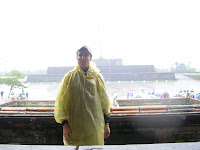
My objective in Hue was to visit the Citadel and Imperial Palace, as these were the main "unseen" sites from my previous visit here. During the trip south bad weather from China caught up with us and I arrived in Hue to almost constant rain. I also discovered that I had left my cap somewhere (Ninh Binh? Hanoi?). The very friendly and helpful hotel staff (I do recommend this place: Tran Ly Hotel on Le Loi Street) told me it had been raining for a few days already!

Eventually (after breakfast and a walk around the nearby streets) I decided I would just have to get out there anyway. So I bought a lightweight poncho and set off walking across the Trang Tien bridge over the Perfume River. First stop was the market for lunch and a cap!

The Citadel covers a very large area. Inside it are the Imperial Enclosure (comparable to the Forbidden City in Beijing) which contained the emperor's residence and the main imperial government buildings, and then inside that is the Forbidden Purple City, which was for the personal use of the emperor. At that point most comparisons with Beijing's Forbidden City complex have to end. Firstly, because the whole Citadel complex suffered drastic damage during the French and American Wars. Secondly, the complex in Hue has much more of a park feel to it. There are models which show the extent to which the Citadel and its enclosures were actually built up, but the use of the moat around the Citadel, the relative space that seems apparent between buildings, and the lakes and parks inside the Imperial Enclosure make a lighter atmosphere. Maybe it's really just a consequence of the first point ...

Much of my afternoon here was spent trudging around in the rain, with the camera getting progressively damper and damper to the point it almost stopped working altogether! Because I was a shutterbug yet again!
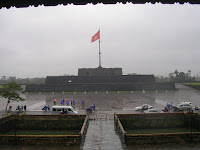
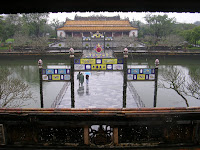
The main features of the outer perimeter of the Citadel are the 10km long walls, the outer moat, and the Flag Tower, seen here from the Ngo Mon Gate, which is the principal entrance to the Imperial Enclosure. The walls of the Imperial Enclosure are surrounded by an inner moat.

Walking through the Ngo Mon Gate you approach Thai Hoa Palace across a large pond. Behind this are the Halls of the Mandarins which have been restored, and beyond them (behind a broken down wall) was the Forbidden Purple City, now almost entirely destroyed.
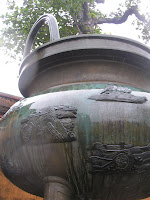
From here I went on to the To Mieu Temple complex, which has also been restored. Here there are statues or pictures of the Nguyen Dynasty Emperors as well as a set of heavy, decorated bronze urns, intended to symbolise the power and stability of the Nguyen throne (although this was effectively distintegrated after 1883 and the death of Tu Duc). The buildings here were peaceful, beautifully decorated and restored, and only a few visitors. This generally is the situation in the whole Citadel because the tours make very cursory and rushed visits. So if you come to Hue - take your time!

Dien Tho Residence is one of the few other largely intact buildings (also under restoration). Around now the rain was falling again but the pavilions and walkways offered shelter as well as a close-up view of where the Queen Mothers lived and received visitors.

From here I skirted around the walls and along the streets of the Imperial Enclosure to make my way past Truong San Residence (in ruins but praised in 1844 by Emperor Thieu Tri for its gardens as one of the top 20 beautiful spots in Hue). Then past some administrative buildings from Bao Dai's era, and the Thai To Mieu temple complex which provides a counterpoint to To Mieu.

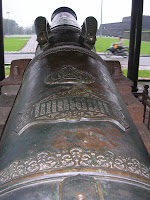
The next day I revisited the outside of the Imperial Enclosure making my way from a gate on the eastern side, around to the five cannons near Quang Duc gate, representing the five elements: metal, wood, water, fire and earth. From here I made the 7km trek to Thien Mu Pagoda (yes, on foot!)


Thien Mu
David and I came here in 1999. It is an iconic site for the Vietnamese, and features in many idyllic paintings, poetry and songs. It also has political significance for demonstrations against the South Vietnamese government of Ngo Dinh Diem. From here the Buddhist monk Thich Quang Duc set out in 1963 on his journey to Saigon and his death by self-immolation in protest against the treatment of Buddhists by the government.

There was much more to the pagoda than I remembered. Perhaps that is an accident of having visited the first time as part of a tour on the Perfume River to visit the Royal Tombs. I elected to return to Hue by boat, but the hotel staff were still amazed that I had walked so far!


De-Militarised Zone (DMZ)
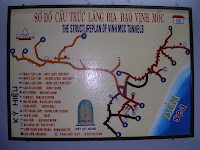
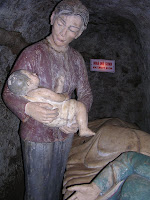
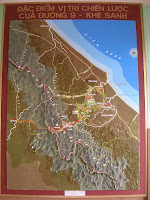
On my last full day in Hue, I took a tour to the de-militarised zone. The itinerary promised a huge number of sites, but given that we also had long distances to cover from Hue up to Dong Ha then further north to Vinh Moc, then back to Dong Ha and up the Truong Son mountains to Khe Sanh combat base, I knew not to expect too much. The main thing for me was to visit the Vinh Moc tunnels. These are different to the tunnels at Cu Chi because their use was as much civilian as military.
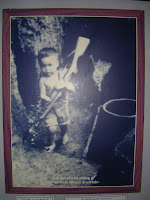
Vinh Moc village came under constant and heavy bombardment from the Americans and the south from 1966. Many villagers left, but some remained with the encouragement of the Viet Cong. For about 4 years daily life moved underground. 17 babies were born in the delivery room in the tunnels, and families lived, cooked, ate, washed and slept here.

The other main visit of the tour was to Khe Sanh Combat Base. One of the other Australians on the tour joked that many visitors must come because of the Cold Chisel song, maybe expecting to see some links to the band or Jimmy Barnes. Here we were given an excellent commentary about the base and its history by the director of the base museum. This is the principal feature - evidence of the massive air field that was built here is almost extinguished, except for one thing. The outline remains distinct because nothing will grow on it.

Friday, January 01, 2010

Museums: Hanoi

I arrived back in Vietnam (Ha Noi) in the evening of 10 November. The next morning I met up with Ellyn and Elsbeth (former colleagues at ILA Vietnam in Vung Tau) for brunch. Then Elsbeth and I went to the Ha Noi Museum of Fine Arts, conveniently located just across the road! Elsbeth's mission was to visit as many museums and cultural places in Ha Noi as possible before she left Vietnam to return to Minnesota later in the month. This museum was also part history, because it charted art, ceramics and sculpture in Vietnam from the earliest times. Some of the most impressive works I saw were modern, socialist-era pieces using traditional lacquer-ware techniques. The colours were used brilliantly to give life to the pictures.

Museums were really the recurring theme of my visit to Ha Noi, apart from walking many times around Ho Hoan Kiem (Returned Sword Lake). I tried mainly to visit places that I hadn't seen before, but in this time I revisited Van Mieu (Temple of Literature) as well as Ngoc Son Temple on the island in Ho Hoan Kiem. Van Mieu seemed very different to the first time I visited with David in 1999. This is partly because of a new, though traditional-looking, complex added behind the main Khue Van Pavilion, to record the contributions made by some of the most significant kings to the creation of the university.

At the Museum of the Vietnamese Revolution and again at Hoa Lo Prison museum I got some great insights into the long nationalistic struggle of the Vietnamese to gain independence. This journey started almost at the same time that France gained it's stranglehold in Indochina, and so (at the Museum of the Vietnamese Revolution) includes the resistance of some of the nationalist emperors, as well as the long list of revolutionary heroes throughout the 20th century. I ran out of time (because Hanoian museums have very early closing times and shoo everyone out at least 15 minutes prior to that!) so was still only part way through the struggle for reunification.

At Hoa Lo Prison the focus is three-fold: firstly, on the demolition and up-rooting of the community that lived here at the time the French decided this was the perfect location for the prison; secondly, on its use as a political prison; and thirdly, on its history as the Hanoi Hilton, housing American prisoners of war. Through visiting both these museums I started to recognise how many streets are named after revolutionary heroes - men and women.

One afternoon, I walked from the old quarter across to the Ho Chi Minh Mausoleum area. It was too late and the wrong day to go and pay my respects to Uncle Ho, but I did get the chance to look through the Ho Chi Minh Museum which has a great mix of exhibits combining Ho Chi Minh's personal/political history with the development of socialist Vietnam. Again, the closing-time wardens pounced just as I got through all the exhibits. Supposedly no cameras are allowed here (s0 I checked mine in) but I saw it happening all the time so took a couple of surreptitious shots on the phone-cam . Walking back I took a quick geek at the One Pillar Pagoda (I remember David's extreme disappointment the first time we visited - he expected so much more, and found an oversized bird-box!), and the Flag Tower in the old Ha Noi Citadel.

The other museum I visited was the Vietnamese Museum of Ethnology. This required a taxi ride because it's some distance away from the city. It was very interesting to come here after going to Sa Pa and it helped me to get a much more expansive idea of the different minority groups in the Vietnamese population. The museum has good indoor and outdoor exhibits. For once I agree with LP - it shouldn't be missed.

Museums: Cambodia

One of the recurring things I did on my holiday was to visit museums. David would have been extremely bored if he'd been compelled to come with me!

I've already written about Tuol Sleng, a place outstanding and memorable for non-conventional reasons. While in Phnom Penh I also visited the National Museum of Cambodia, and Royal Palace compound, including the Silver Pagoda, and Wat Phnom.

The National Museum focusses on the architecture and archaeological history of Cambodia. It includes some of the best examples of Angkorian sculpture, which has been removed from the Siem Reap temples and palaces for safe-keeping. The building itself is made up of a number of pavilions with a peaceful garden courtyard. Generally a quiet and restful place although there was a very large group of Korean students visiting while I was there.

This was my first post-lunch stop on my second - dry - day in Cambodia. In the morning I had taken a tuktuk to Wat Phnom and then started walking through Phnom Penh, basing my route on the walking tour in Lonely Planet. This is easy to do - if rather hot - because Phnom Penh is small geographically. I tried checking out the central market Psar Thmei but much of it was closed for renovations and what there was to see was exceedingly bland. I also found the architecture vastly over-rated, given the guidebook descriptions of it as resembling "a Babylonian ziggurat". Say what?! I think the alternative description of "a concrete custard pie" is much more like it!!

Wat Phnom is the hill-top pagoda from which the city traces it's origins. There has been a pagoda here since the 1300s, although like so much of Cambodia's religious heritage, it suffered badly during the Khmer Rouge government. It's still a community focal point, with many visitors in the park around the hill, hawkers, stalls and many beggars, especially children.

After the National Museum I still had time to tour the Royal Palace compound. This is the official residence of the king so not everything can be visited, but I had the chance to venture inside the Throne Hall and the Silver Pagoda. Photography is not allowed inside either, so the pictorial record is reduced to postcards bought from a disabled street vendor. Printed and copied so many times much of the vibrancy of the colours has been washed out . However, there is still plenty of colour to see of and from the exteriors. The Throne Hall central spire is topped by a most unusual sight, a face. I have no idea if it is a religious or royal representation. Maybe both?


In Siem Reap, aside from the massive museum that is the whole Angkorian collection, I visited the workshop/school of Les Chantiers Ecoles. The school teaches impoverished young people the techniques of carving wood and stone, as well as teaching deaf people silk painting, and a group of young men how to make silver-plated objects. The products are very high-end in quality - with prices to match - but the principle is also to return a fair-value to the craftsmen and to bringing more teenagers into the training program.

During the 2nd day of my journeys to the Angkor Wat temples we also stopped in at the Cambodia Land Mines Museum. The museum was established by Aki Ra, a DIY but expert de-miner. His own history tells you something of the torment and struggle to survive that the older generations of Cambodian people all had to face. He was removed from his family in the early days of the Khmer Rouge and became a soldier for them, before later defecting during the Vietnamese-backed administration. During his life he has had many names, now going by his adopted Japanese name. Initially his career as de-miner - trained by the UN - was outside the work of any agency. Now there is an NGO supporting the museum as well as the education facilities and dormitory that Aki Ra and his family provide for disadvantaged (often extremely impoverished) children in the area. See Ottawa Treaty for some information about the international cooperation needed to ban landmines.

Monday, December 21, 2009

Phnom Penh: Tuol Sleng

It's too easy in Vietnam and Cambodia to be aware only of the present time; the recent prosperity (for some), the relative invisibility of the poor (the majority); the similarities to our own 'home' environments with the local twist. It's too easy to let slip away an appreciation of how recent these things are, and a recognition that these societies were in very different circumstances not so long ago.

Tuol Sleng Museum - Security Prison-21 in the Pol Pot/Khmer Rouge regime - is a difficult place to visit. It's quietness and ordinariness don't prepare you at all.

You arrive with only an academic understanding of the horrors that took place here. But within minutes of glancing, even walking into the detention rooms of Building A you feel heavy with the souls of the tortured and dead. This feeling stays and stays... as you look bleakly at the rooms and rooms of photographs of inmates or contemplate the schoolrooms turned into tiny, dark cells.

Perhaps this was not the best place to start a holiday, and it certainly is not a place to consider visiting lightly, but I think, however dark its history and presence, that what Tuol Sleng Museum preserves is necessary for an awareness of what people have been capable of doing to each other. The personal recollections of a Danish man who visited Democratic Kampuchea between 1975 and 1979 as well as his later reflections on what he believed he was being shown and the photographic record, are a strong lesson about the dangers of political idealism detached from social conscience.