Monday, August 27, 2012

Đà Lạt trip: Part 2

Langbiang Mountain

Our first full day in Đà Lạt started with sunny bright skies and warm temperatures. After breakfast, we headed out of the city down one of the many valleys towards Langbiang mountain, stopping for a coffee on the way.

Langbiang mountain is one of the highest mountains in the Đà Lạt area, so coming here on such a clear day meant that we got fantastic views across the other peaks and valleys. Maybe I have said it before but the domestic tourism industry in Vietnam is developing at a great pace, so these days Langbiang is not simply a mountain out of town, but a massively-attended full-on tourist experience, combining minority people cultural shows, break-neck speeds by jeep up the mountain (or if you like, a rigorous hike), horse rides and photo opportunities with some Đà Lạt cowboys, and of course, plenty of opportunities to eat and drink. Being a national holiday, the car park was chock full of coaches as well as private cars such as ours.

This meant waiting for some time to secure jeeps to take us to the peak of the mountain, where we had just 40 minutes to look around before the driver was scheduled to take us back down. All the descriptions I have found on-line highlight just how stupendous the views are. They are not wrong. At 2,167 metres above sea-level Langbiang is also a good 600 metres higher than the official height above sea-level of Đà Lạt city (because the city is such an up and down experience being built on the hills around Xuân Hương river/lake it's difficult to say exactly how high it is). The climb, by whatever method and at whatever speed, is also breathtaking for its steepness and beauty, travelling through pine forests and across narrow ridges.

There are a number of legends associated with the mountain. You can read about two of them here.

Golden Valley - Thung Lũng Vàng
After descending from the mountain, we took a trip along one of the innumerable valleys in the area to the Golden Valley tourist resort; in Vietnamese Thung Lũng Vàng. The link I have included here states that the park and resort are built near the water plant, however, I think that this is a euphemism for water/sewage treatment!. The adjacent lake is actually fenced off and although I didn't notice any explanation for this, my guess is that it is not safe to swim, play or fish in it. However, the park is quite beautiful and the range of scenery and landscaping that has been installed also makes it an attractive place for couples to take wedding photo albums.

We had lunch at a restaurant just outside the park entrance, with the highlights being barbecuing wild pork meat for ourselves and drinking can wine, which is a rice wine made in and drunk directly from a ceramic jar. Bi again displayed his curiosity in all things by experimenting with the barbecue fire to see how the grilling system worked and what manner of leftover foods could be cooked this way. All around us were coffee plants: Đà Lạt's temperate climate and high rainfall make it an ideal location for growing coffee, tea, flowers and a very wide range of fruits and vegetables, both Asian and exotic.

On the way back to the city we stopped off to visit a strawberry farm, another famous product of Đà Lạt, although I am not sure the Australian practice of allowing visitors to pay to pick their own strawberries is followed here.

Love Valley - Thung Lũng Tình Yêu

The final destination for the afternoon was Love Valley, Thung Lũng Tình Yêu, a place that surely every visitor to Đà Lạt has been to. Again because of the national holiday it was very busy here, much more so than when I last visited with Michele, Killki and Chaska in 2009. Being partly for lovers, partly for families, there are also plenty of attractions for kids (big ones too!) here such as dodgem cars, mini-roller coasters, and miniature cyclos.


Sunday, August 26, 2012

Đà Lạt trip: Part 1

Early in the year, Bảo and I discussed taking Bi (and maybe another of the P Centre children) on holiday with us. The Centre supported the idea, and so we asked Bi his preference between Đà Lạt and Nha Trang.  He chose Đà Lạt .... and after discussing with Mỹ Hương we decided that Thuận would be Bi's travelling companion.

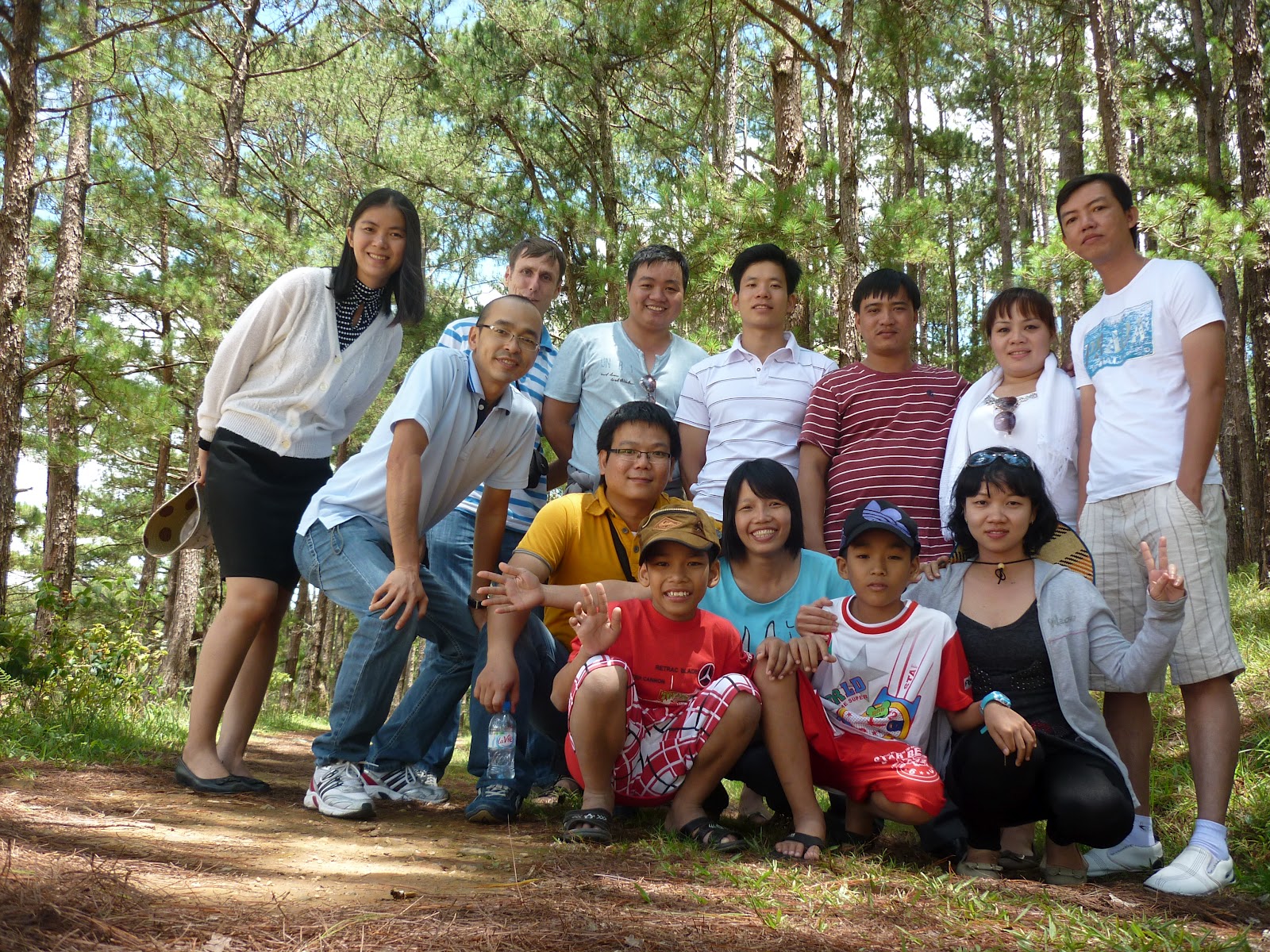
Our initial plan was to travel from Vũng Tàu to Đà Lạt by bus. There were two options: travelling by day on a seated bus, or at night by a "lying" coach, but I had to work on Friday night, making day travel the only possibility. Then at the beginning of the week some of Bảo's colleagues announced that they also intended to take a trip to Đà Lạt for the 30 April/1 May holidays, so we joined forces with them to hire a mini-van and travel together. All up we made a party of 14 people, with all the driving done by Đạt (a big thanks to him and the copious amounts of coffee he drank!), setting out at 4.30am with the expectation of being able to arrive in Đà Lạt by the early afternoon.

At around 10am near Madagui we happened on a stall selling durian. Travelling with a group of durian lovers sort of made a stop here inevitable :( Oh well, at least there was coffee to be had as well. Being security-minded travellers we locked up the van, but forgot to take out the cameras. Bảo and I both wanted to get some shots so we got the key, tried opening the back to reach our bags, discovered that the lock didn't work well and so opened the door from inside, got our cameras, locked the car, shut the back door, checked to make sure it was locked and ... snap! went the only key in the lock!

After that ensued some very tense moments as we tried and failed to extract the broken part of the key from the lock. The next step was to send for help from the nearest town. Help arrived, managed to get the key out, and by use of a very large file attempted to make a copy that would ultimately fail to work. We needed a more technological approach.

To get this we needed to send someone to the next larger town - Bảo Lộc - which was achieved by Đạt being given a ride by another group, and returning with the locksmith with a group travelling back down the mountains. They arrived with another copy of our original patched together key which .... didn't work. After a lot of refinement, the locksmith eventually put together a key that opened the car door.

The next challenge was to get the key to work in the ignition; a different proposition altogether, confounded by the subsequent discovery that putting a non-authentic key in the ignition too many times triggers a shut-down mechanism. I don't remember how we overcome this one, but eventually this extremely talented locksmith reshaped the key sufficiently to get it to consistently open the driver's door and turn the engine over.

How long did this sorry exercise take? Approximately 6 hours which meant we only got back on the road at around 4pm, the time by which we had originally expected to be well and truly ensconced in our hotels in Đà Lạt! Actual arrival time? 8.30pm with dinner time finally coming along at around 9.30pm. This is not an ideal time to be looking for a solid meal in Vietnam, and we ended up in a snail restaurant (which is more typically a drinking place than one for eating). At least there were some noodles and rice for two very hungry and tired boys.

Here are some pics of waiting - patiently and not so patiently - for a workable key. During this enforced stop-off, Bi's continual comment was "Đà Lạt xa quá!" (Dalat is so far away!). However, he also showed his typical curiosity in all operations, watching the work of the locksmiths closely :)

Long Hải Stage 2 Opening

Way back in 2009 I wrote about the opening of stage 1 of Long Hải Centre for the Social Protection of Children (aka "orphanage"). Since then Long Hải Centre has operated as a school for poor and disadvantaged children in Long Hải town, with enrolments each year generally hovering around 110 children studying across 5 grades of primary school, and aged between 7 and about 14 or 15 years old.

The long-term goal of APER for the centre has always been to include residential care, both for disabled children affected by the residual presence of Agent Orange in the district over 40 years, and for homeless, abandoned or at-risk children. On 17 April 2012 this dream was finally realised with the official opening of stage 2 of the centre.

Here are a few photos from the opening day. Aside from very many, and very long, speeches in Vietnamese and French (which language did I find more informative!?), there were performances of martial arts and dance by some of the students at the school and some of the children from P Centre in Vũng Tàu. I travelled with them and some of the staff by mini-bus - always fun to spend time with the kids!

 
Remember: although it has an official name Trung Tâm Bảo Trợ Trẻ Em, and a formal relationship with the government through the local People's Committee, Long Hải Centre is funded almost entirely through the efforts of APER and donations by corporations and private individuals. The Centre needs your help to continue to provide care, education and social development for the children - you can make a donation (http://www.vungtau-orphanage.com) or support a project (http://titibititiem-projects.blogspot.com/).


Wednesday, June 27, 2012

Are you still there?

You could easily be forgiven for asking that question. A look at the last post shows that it is 9 months since I wrote anything here at all. So very sorry about that!

Yes, I am still here in thành phố Vũng Tàu, Việt Nam, on the brink of a change in employment (but not scenery) as I have just 4 days to go on my contract with ILA Vietnam, after which I will only be teaching privately. Some busy times are coming up, but I hope that the Internet gods and my schedule will give me a chance to update everyone on some of the travels that Bảo and I have made during the past 9 months.

In the meantime here are a few 50th birthday pics! The card was made by my very creative and talented colleague Lisa. Edwin and Ý joined me and Bảo for a birthday dinner at Vỹ Dạ restaurant, and treated me to many types of chocolate cake. Edwin also kindly reversed the number order for the candles!


Saturday, September 24, 2011

South again

Vietnam National Day (2 September) was on Friday this year, giving us a chance to take another short trip. Bảo had been thinking recently about his great-uncle, who is a great favourite with his family and the only sibling of his mother's mother still living. That settled it - we were heading south again, to Sóc Trang province.

The only difficulty with this idea? I was teaching on Thursday evening, which limited our choices in departure times and bus operators . In the end we opted for Hòa Hiệp company, leaving Vũng Tàu at 3.00am the next day. Sadly, this was not such a good choice. Knowing already that it would not be air-conditioned, we turned up at the bus station at 2.30am to discover it was a rather small vehicle that would become vastly overcrowded once we set out. Oh well, it served the purpose and delivered us to Sóc Trang city by 11.00am. And at least we had real seats instead of plastic stools.

There we ate lunch while waiting to meet one of Bảo's numerous cousins, who helped to engage two xe ôm drivers to take us to our real destination of Kế Sách district and the village home of great-uncle, his wife, sons and daughters and grand-children. (In the picture on the left Bảo is the same generation as the young girl - the woman is her mother.) It took a bit of asking to find the house, but it seems most people know great-uncle. Later we were to discover this is in at least part due to his skills/reputation as a traditional healer. I soon discovered why great-uncle is such a favourite with his family. His personality is so expansive and engaging, and at 85 he is still lively and active. I feel honoured to have been received into his home.

After dinner that night one of the uncles took us to drink coffee and then to eat bánh xeo miền tây. Walking back home he also pointed out some of the features of the village which sits at the junction of a river and one of the branches of the Mekong. The next morning we had breakfast of bún mắm in the market with uncle and great-uncle, who then took us on a walking tour of the village centre and the pagoda. Here we met the monk and found out about the work being done to renovate rooms behind the pagoda where old people with no family can come to live. The big community room behind the pagoda has many brightly coloured pictures of the various Buddhist hells.

Then uncle took us across the river (Mekong) to the island where he is a teacher. Here we visited many houses of colleagues and friends, drinking a huge assortment of beverages ranging from coconut juice to beer and coconut wine to iced coffee and nước ngọt. It reached the stage where we could hear the ice being chopped up at the next house and had to request "no more, sorry!".

Back at great-uncle's house we ate lunch and then met more family members, this time including the son of another deceased great-uncle, who of course Bảo should properly call "uncle" even though he is 7 years younger. They did do this when they were boys, but now the uncle calls Bảo "anh". While everyone talked I looked around the grounds of the house more, discovering the range of fruit trees, and learning that the tidal patterns of the Mekong are the reason that most houses in the delta stand on tiny islands surrounded by ponds. This had always been a mystery to me. By the way the scullery of the house is outside over one of the ponds and this is also where we brushed our teeth.

That evening we returned to stay at Sóc Trang, before venturing on the next day to Bạc Liêu, where (you guessed it) there was another cousin to meet and take us around. The idea was to hire him and his friend (they are both xe ôm drivers) to take us around but at the end of the day the cousin steadfastly refused to accept payment. Thank you so much for welcoming us!

Our first destination was a town half way to Cà Mau, the southern-most province/city of Vietnam. Here there is a huge - I mean gi-normous - church as well as a museum and chapel dedicated to the most famous priest of the area. From there we turned back towards Bạc Liêu before leaving the highway and travelling several kilometres through farmland to reach a large temple complex dedicated to Quan Am. At this point we were now almost at the sea, although I didn't realise it. Bảo relayed to me that in the living past the land where the temple now is was on the coast, yet all we could see in front of us was more land and then mangroves. It wasn't until we crossed a small river just to the north of the temple that I understood and truly appreciated the extent to which Vietnam is visibly growing each year as the Mekong deposits more and more silt into the ocean.
On the way back into the city we had time to visit the Bird Sanctuary. Looking at my road map book for Vietnam I now know there are a number of bird reserves in these southern-most provinces, established in mangrove areas and providing sanctuary for an abundance of water-birds, including herons and cormorants. Really the birds are free to come and go, but there is also a large netted area to give them safe haven, along with ground-dwellers, and we were in time to see some of the birds being fed.

Our final destinations were 1) the tomb of a very famous cai lương song-writer and singer. This style of music is the traditional one for the south but is not to everyone's taste! 2) the mansion of a man reputed (still) as the richest man in Bạc Liêu. A good place to read about both of these tourist features of the city is here.

Then all too soon our time was up, and it was time to travel 10 hours back to Vũng Tàu. Again not without its surprises. The manager of the hotel we stayed at in Bạc Liêu recommended using her friend's private transport service to get back to Hồ Chí Minh City. No problems there and it was a smooth trip using the new freeway alternative to highway one. However, we were dropped off a long distance from Bến Xe Miên Đông, and had to take a local bus - a new experience for me - from outside Đam Sen water park to reach the bus station.

Weekend Trip

After close to 3 years, I no longer work on weekends! And that gives a chance to take weekend trips away on the motorbike + Monday if Bảo can have the day off. Our first destination: Phan Thiết, about 170 kilometres up the coast from Vũng Tàu. Mũi Né,- fishing village cum major tourist destination, is just a bit further from there (went there with David back at the beginning of 2009).

We worked out from looking at the map and advice from colleagues (Bảo's and mine) that we would not have to venture onto national highway 1 at all for the trip - a great bonus to stay away from the traffic. The route took us from Bà Rịa-Vũng Tàu province, via Long Hải and Bình Châu into neighbouring Bình Thuận province, travelling parallel to the coastline to La Gi where there is an option to turn inland to highway 1. Instead we took the lesser road sticking with the coastline and travelling past what appear to be volcanic mountains and through the thanh long (dragon fruit) fields to the village of Kê Gà. Here we stopped - literally on the beach - to take a (still distant) look at the lighthouse, before continuing on in the southern approach to Phan Thiết city. This road in is also in the throes of resort development but hopefully will remain much more restrained than Hàm Tiên/Mũi Né.

As regular readers know already, Bảo has contacts everywhere! Phan Thiết is no different where one of his former colleagues from Kinh Đô company (Tây Ninh days) now lives with his young family. He helped us find a reasonably priced hotel in the city, next door to Co-opMart, and we met a couple of times more during the weekend for coffee, etc.

In the afternoon we tackled highway 1 so as to drive back out of the city to one of the biggest mountains in the area, Núi Tà Cũ. Bảo's previous visit was on pilgrimage when he climbed up the mountain at night so as to reach the pagoda by midnight. This time we had the cable car available to us - it leaves Vũng Tàu's in shame incidentally for length and price and it took us up one high slope and then partly down the next one to reach the pagoda complex. From here we could also look back to the coastline along which we had ridden earlier in the day. The photo shows clear weather, but this is rainy season and it set in with a heavy downpour on the ride back to Phan Thiết.

The next day we decided to head north to Mũi Né. Properly speaking all the development is in Hàm Tiên village rather than Mũi Né, but for some reason it's the second name that has stuck. I thought it was getting over-developed last time I was here; now it's just kilometres of resorts and hotels, with the beach getting eroded by the sea and the water itself polluted by the thrill-seekers on sea-doos. Very disappointing and we would have been better to stick to Phan Thiết beach ...

On the way back we stopped to take a look at Po Shanu Cham towers, a simple vestige of three Cham-era towers on a headland. Compared to other sites in the central-south of Vietnam, or at My Sơn, the towers are nothing much but the setting is still peaceful and beautiful.

Monday came it and was time to retrace our steps home.

Tuesday, June 28, 2011

Phu Quoc

Phú Quốc is a beautiful, peaceful and relaxing island in the very south of Vietnam, almost closer to Cambodia than it is to mainland Vietnam. You can reach it by high-speed or slower boats or plane, and many people in Vietnam and from abroad do choose to come here. Yet despite it's popularity it remains relatively quiet and it is not (yet) over-developed as a travel destination. Perhaps one reason is that the airstrip is small, only Turbo-props and the like can land/take-off from here.

Last year, Bảo and I were almost within striking distance of Phú Quốc when we trekked south to Rạch Gía and Hà Tiên on the April/May national holidays. This year, together with An, and aided by the decision of Vietnam Airlines to put on additional flights, we took the extra step ...

... staying in a small, beachside resort along Long Beach. It wasn't plush and wide like it's neighbours but it was comfortable and clean and the right price for our collective budget. It was also just a couple of kilometres south of the main town, Dương Đông, a walkable distance.

On our first afternoon/evening we tried out the beach, encountering the first of many jellyfish that would be part of our visit. Then we walked into town to take a look at what is translated to English as Cau Castle, but which is in fact a tiny lighthouse combined with a temple dedicated to the goddess of the sea, and standing at the entrance to Dương Đông port. It is also adjacent to the town beach, which was crowded with swimmers, walkers and young guys jumping from the rocks into the sea. Finally, we had dinner in the night market - very hungrily as we had missed out on lunch :(

The next morning we rented two motorbikes so that we could explore the island further afield. Our intended destination was Bãi Sao (not to be confused with Vung Tau's Bãi Sau!) but with a visit to the pearl producers along the way. Pearls, along with fish sauce and pepper, appear to be the main products of Phú Quốc, and there are very many "factories" set up around the southern areas of the island. We spent a few hours beside and in the beautifully clear water - again in the company of many jellyfish, although I discovered if I swam slowly enough they were aware of me and would move away. Unfortunately I acquired a rather red skin as well (sunburn).

In the mid-afternoon we sought out the prison near An Thới town. Like many islands around the world, Phú Quốc was used as a political prison in the past - by both the French and the Americans. While the Lonely Planet website says otherwise, there is actually a museum here recording the crimes inflicted on the Việt Công and Việt Minh by the foreign nations and the South Vietnam government. We didn't linger because Bảo and An overheard some remarks directed towards me ...! Finally, we completed a round trip of the southern part of the island by stopping off at the national park, and then a pepper farm. An enjoyable ride, without a lot of traffic, but with a lot of red dust. There is also some massive road-building going on, leaving me wondering about expectations for the future population of the island.

Phú Quốc is actually famous for its fish sauce, and Bảo wanted to try and find the factory for the brand that his family prefers. After some driving around we tracked it down, and although really the factory was closed for the holiday, the owner gave us a look inside and told us a bit about production. This factory is different from many because they continue to use wooden casks for brewing? fermenting? the fish sauce in. Actually the smell was not too bad and it was interesting to see the process.

Afterwards Bảo and I rode north to Bãi Dài, another long, beautiful and only sparsely frequented beach. One of the lovely things about much of the coastline on Phú Quốc is that it is lined by pine trees that leave a blanket of needles on the sand almost down to the sea. Everywhere the water is clear and clean. Out this way there are a few resorts - imagine how it might be to stay in this tranquility.

And then ... the trip was over. Back to work.